

Get the MiCA Program Guide

Does your team meet ESMA's competence standards? Get the free MiCA Program Guide.

(Ask Me Anything).


MiCA Certification Programs for CASPs
Meet ESMA's new knowledge and competence requirements with our specialized MiCA certification programs designed for CASPs, developed in partnership with The Big Whale.



Our certified members are employed by leading financial institutions and crypto companies worldwide















Two Certification Pathways
Choose the certification that matches your role and responsibilities at your crypto asset company. Program customization available upon request.

MIC™
Designed for professionals who provide information on crypto assets or CASP services. The MIC™ ensures staff can deliver accurate, compliant information to clients under MiCA regulation.
Client-Facing & Information Staff
Core Knowledge Areas
Program Content
Client-Facing & Information Staff
MAC™
Built for professionals who advise clients on crypto asset investments or portfolio strategies. The MAC™ validates advanced competence for advisory roles under MiCA regulation.
Advisors & Portfolio Managers
Core Knowledge Areas
Program Content
Client-Facing & Information Staff

Modular Program Options
Both programs are built from self-contained modules. Clients who wish to customise the scope and duration of the program can do so: they select the modules relevant to their teams and choose a version ranging from 10 to 80 hours. The 10-hour and 20-hour versions are offered as the MiCA CPD programs.
What your team receives
Successful candidates receive a professional certificate co-branded by DEC Institute and The Big Whale and accredited by The CPD Certification Service. Each one is digitally verifiable: a unique ID and QR code let an employer or a supervisor confirm it in seconds.
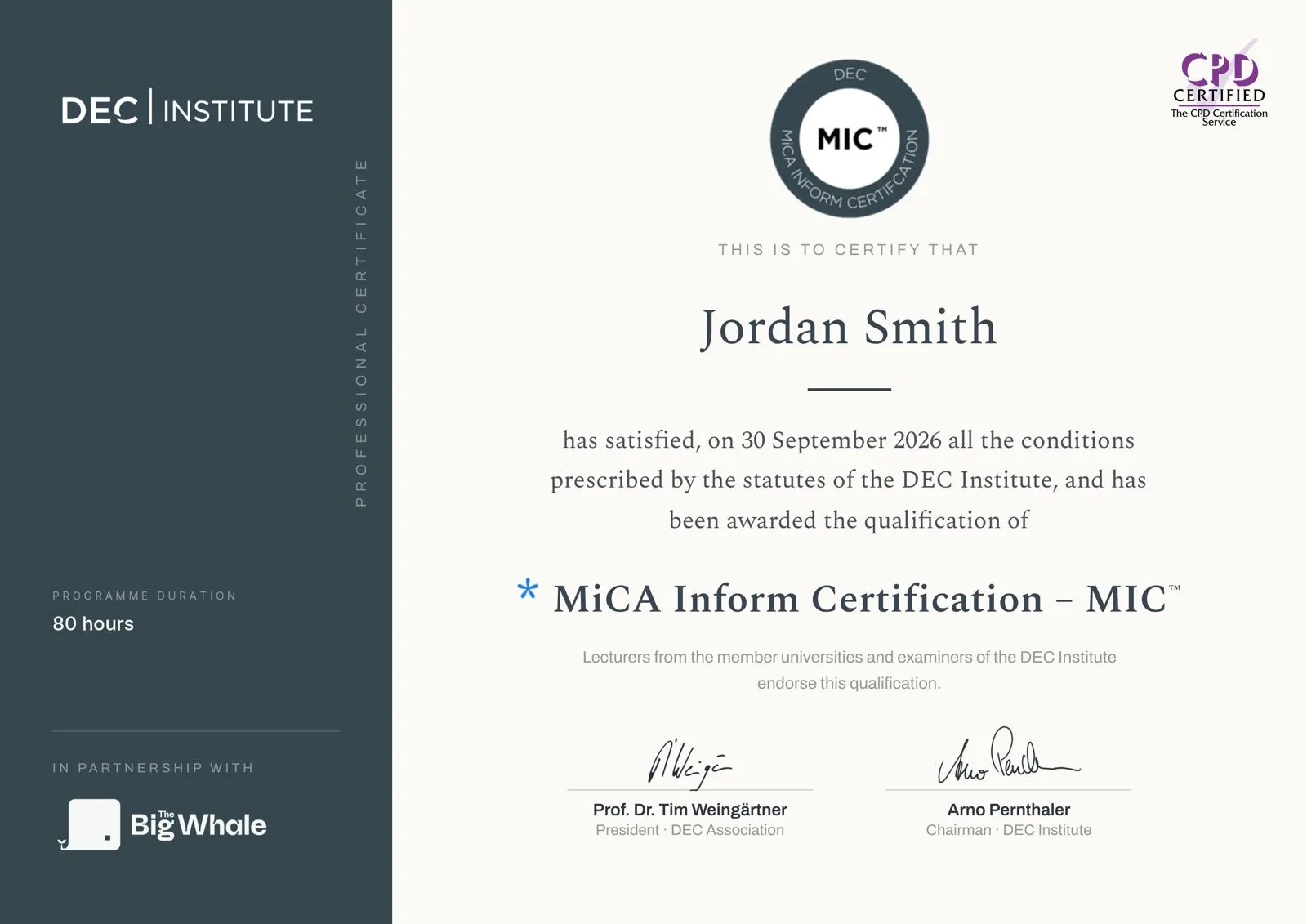
Illustrative sample. View a credential we have issued
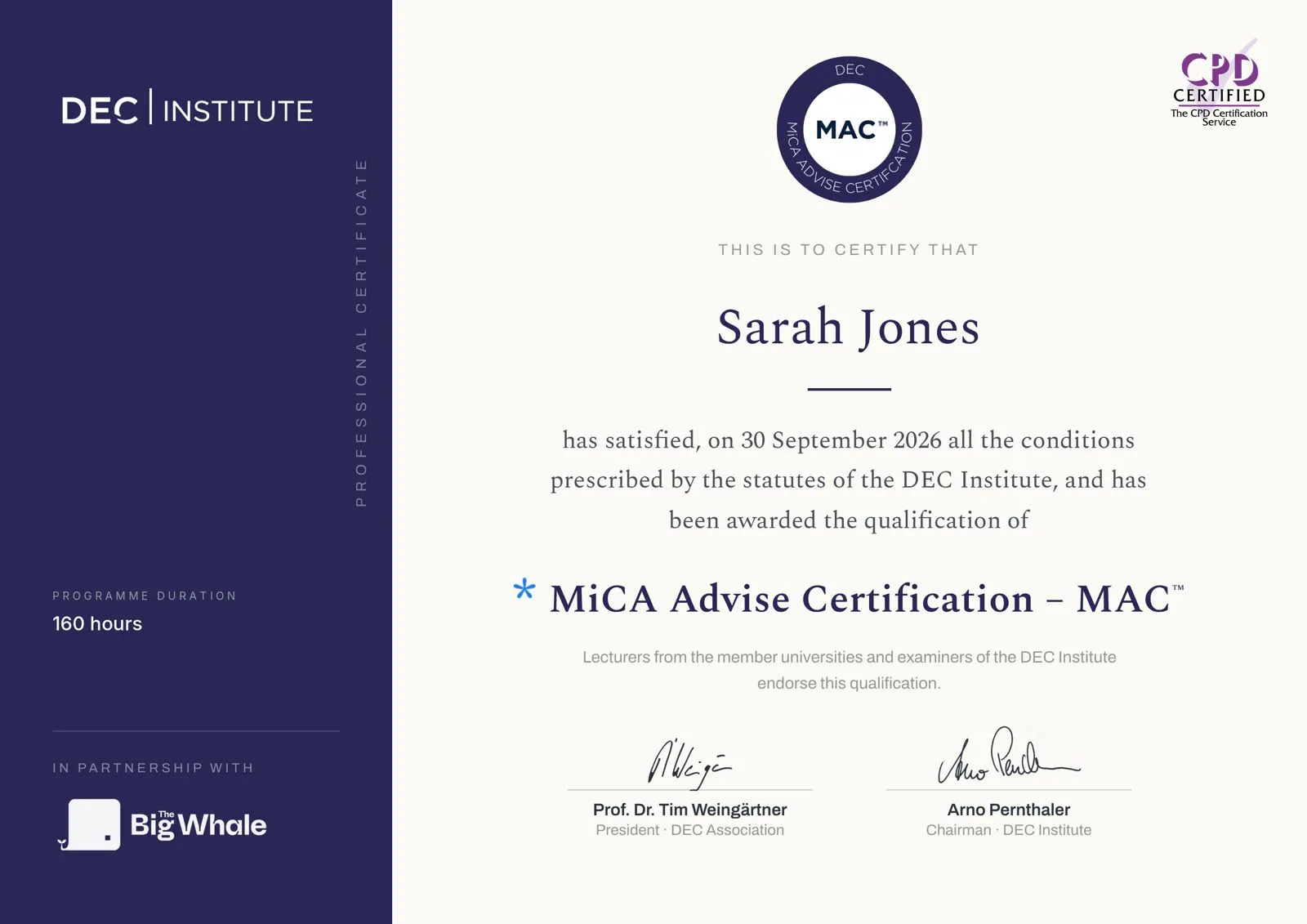
Illustrative sample. View a credential we have issued
MiCA Changes Everything
for Crypto Professionals
The EU's Markets in Crypto-Assets regulation introduces mandatory competence requirements. Here's why your team needs to act now.
Regulatory Mandate
MiCA (Markets in Crypto-Assets Regulation) is the EU's comprehensive framework for crypto assets, effective since December 2024. It introduces mandatory knowledge and competence requirements for all staff at Crypto Asset Service Providers (CASPs) who provide information or advice to clients.
EU-Wide Standard
For the first time, a single regulatory framework governs crypto asset services across all EU member states, replacing the patchwork of national rules with a harmonized approach.
ESMA Requirements
ESMA's guidelines mandate that CASP staff providing information or advice on crypto assets must demonstrate appropriate knowledge and competence - verified through certification.
CASP Compliance
Crypto Asset Service Providers face supervisory scrutiny. Ensuring your team holds recognized certifications demonstrates compliance and protects your license to operate.

Gregory Raymond
"MiCA's knowledge requirements aren't just a compliance checkbox. They represent a fundamental shift in how crypto firms must professionalise their client-facing operations. The industry now faces the same standards as traditional finance, and those who fail to adapt by July 2026 will find themselves at a significant competitive disadvantage."
Latest Intelligence
Get the latest regulatory insights and MiCA developments from The Big Whale's monthly regulatory briefing.
Official ESMA Guidelines

Our certification programs are built in accordance with the European Securities and Markets Authority's official guidelines on knowledge and competence requirements, published in July 2025 and January 2026. CASPs must ensure compliance by July 28, 2026.
What you will master
A rigorous curriculum mapped directly to ESMA's knowledge and competence guidelines. Modules 1-6 form the MIC™ program; all 12 modules comprise the MAC™.
Program Mapping
MIC™
MAC™
Assessment
Each module includes knowledge checks and case studies to reinforce learning.
Passing a proctored examination is required to earn your certification.
What's Included
The MiCA Regulatory Framework

Crypto-Asset Fundamentals
Crypto Risks and Security
Costs and Markets
Legal & Ethical Responsibilities
Valuation and Sustainability
Advanced Crypto Asset Knowledge
Suitability Frameworks
Portfolio Management
Risk Profiling
Investor Protection
Costs & Charges
The DEC Institute Difference

Everything You Need to Know
Common questions about MiCA certification programs and our programs
What is the difference between the MiCA Inform Certificate (MIC) and MiCA Advise Certificate (MAC)?
The MiCA Inform Certificate (MIC) and MiCA Advise Certificate (MAC) reflect two distinct levels of regulatory competence, aligned with staff roles defined in Article 81(7) of the Markets in Crypto-Assets Regulation (MiCA).
MIC certifies that a person is competent to give information about crypto-assets or services. This includes explaining product features, risk warnings, or costs, but without offering personalized recommendations.
MAC certifies that a person is qualified to give advice, meaning they are authorized to provide personalized investment recommendations on crypto-assets or crypto-asset services. This triggers additional legal obligations under MiCA, such as suitability assessments.
Only MAC-certified staff may perform advisory functions. MiCA requires CASPs to clearly distinguish between these roles, both in practice and in internal policies, and to ensure that only qualified individuals act in either capacity.
How does MiCA define "giving information" vs. "giving advice" to clients?
MiCA and ESMA draw a regulatory line between these two functions:Giving information means delivering factual, non-personalized details about a crypto-asset or service. This might include explaining a product's features, how a DLT network works, the risks of volatility, or the costs involved in using a service. It does not involve suggesting what a client should do.Giving advice means offering a personal recommendation. For example, telling a client they should invest in Token A or recommending one product over another. As soon as an employee tailors guidance to a client's situation, it becomes advice, and MiCA suitability requirements apply.Only MAC-certified staff may perform advisory functions. MiCA requires CASPs to clearly distinguish between these roles, both in practice and in internal policies, and to ensure that only qualified individuals act in either capacity.
What qualifications or experience do I need to be eligible for an information-giving role (MIC)?
Under ESMA Guideline 2, a person can qualify to give information about crypto-assets in one of two ways:Path A: Complete a professional qualification of at least 80 hours (such as the MIC certification) and accumulate at least 6 months of supervised experience giving information to clients.Path B: Accumulate at least 1 year of supervised experience, without the formal 80-hour qualification.In both cases, the individual must demonstrate their knowledge and competence through an assessment, which may be administered internally or by an external body. The employer is responsible for ensuring this assessment is rigorous and covers all topics listed in Guideline 2, including risk communication, cost transparency, and fair client information standards.
What qualifications or experience do I need for an advice-giving role (MAC)?
Staff giving advice must meet higher criteria under ESMA Guideline 3. MAC candidates must pass an assessment and meet one of the following qualification and experience combinations:
- A relevant tertiary degree (e.g. in economics, finance, law) plus 1 year of supervised experience in crypto-asset advice.
- A secondary education qualification + 3 years of professional training (in a relevant area) plus 1 year of supervised experience.
- A 160-hour professional training programme (such as MIC + MAC combined) plus 1 year of supervised experience.
- At least 2 years of prior experience giving MiFID II or IDD-compliant advice plus 6 months of supervised crypto-asset advisory experience.
Regardless of the route, the individual must demonstrate competence through both knowledge-based and practical assessments, particularly in areas such as suitability analysis, product comparisons, and regulatory disclosure.
If I already have crypto experience, do I still need to certify under MIC or MAC?
Possibly not. ESMA allows firms to "grandfather" competence for existing staff who have been performing a relevant role for at least 1 year before the application of the guidelines.
For information-giving staff: at least 1 year of full-time experience giving information (with or without supervision).
For advice-giving staff: at least 1 year of full-time experience giving advice on crypto-assets or crypto-asset services.
The employer must document this experience and confirm that it covers all relevant knowledge areas. This is a one-time exception. New hires or those with less experience must follow the standard certification path.
What continuing professional development (CPD) is required to maintain MIC or MAC certification?
MiCA requires ongoing learning:MIC holders should complete at least 10 hours of CPD per year, covering regulatory changes, market developments, and emerging risks.
MAC holders are expected to complete at least 20 hours per year.All CPD activities must include an assessment (such as a test, quiz, or demonstration of learning) and must be relevant to the individual's role. Employers are responsible for setting CPD expectations and tracking completion. External CPD bundles aligned with MiCA may be used to fulfill this requirement.
How do CASPs and individuals demonstrate compliance with MiCA's competence rules?
Firms must maintain documented evidence for each staff member involved in client-facing roles. This includes:
- Initial qualifications or certifications (e.g., MIC, MAC)
- Supervised experience records
- Results of assessments and exams
- CPD completion logs
- Clear role descriptions and competence mapping
Individuals demonstrate compliance by obtaining a recognized qualification (like MIC or MAC), completing supervised practice, and maintaining CPD. Firms are expected to ensure internal policies are in place to assess, update, and record competence annually.
Can staff operate under supervision before they are fully certified?
Yes. MiCA allows staff to perform information or advisory functions under the supervision of a fully qualified individual, with safeguards:
- The supervising staff member must hold the appropriate certification and experience.
- Supervision must be structured and documented. The supervisor is responsible for all client-facing activity, including suitability assessments and reports.
- The supervised staff member must become fully qualified within 4 years. After that, supervision is no longer permitted.
- Firms must be able to demonstrate how supervision is conducted and how responsibilities are allocated.
What happens if I don't pass the MIC or MAC exam on the first attempt?
We provide the opportunity to resit the exam for a small exam administration and platform fee. A waiting period of 4 weeks applies before you can reattempt the examination.
You'll receive a detailed result report that helps identify specific knowledge gaps, allowing you to focus your learning and preparation more effectively for your next attempt. Firms may allow continued supervised work during this period, but unsupervised interaction with clients is not permitted until the assessment is passed.
Prepare Your Team for MiCA Compliance
Don't wait for regulatory enforcement. Equip your professionals with the certifications they need to inform and advise under MiCA.
Choose your Certification Path
Select the certification that best fits your professional goals

Need a Consultation?
Have questions about our MiCA certification programs? We're here to help.
Our team will respond within 24 hours to answer your questions about enrollment, group pricing, or program details.
MiCA Executive Briefing
A strategic session for C-suite and board members, delivered in partnership with The Big Whale
MiCA Executive Briefing
A 2-hour strategic session built for C-suite and board members who need the full picture — fast.
What You'll Learn


Intelligence Partner
Strategic intelligence partner in digital assets for financial institutions across Europe
Trusted by Industry Leaders
The Big Whale is an independent and global market intelligence platform on digital assets. Over 100 financial market participants benefit from exclusive access to our network, events, research, editorial coverage, weekly briefing, and academy.
Expert Intelligence


Fill out this simple form to sign


